Hutton Studios
Hide and SeekHutton Studios is both a working photographic space and a crucial point of contact between Hutton’s work, Brian Holmes’s investigation, and images connected to Ronnie McGrath. Its importance rests on photographs that move beyond the studio: one links Hutton’s work to a picture seen in Ronnie’s bedroom, while a nude photograph of Tracy carries the studio’s label into Rebus’s inquiry. The studio therefore becomes a place where images may be displayed, borrowed, or suspected of having changed hands, even as the full history behind them remains uncertain.
The Studio and Hutton’s Work
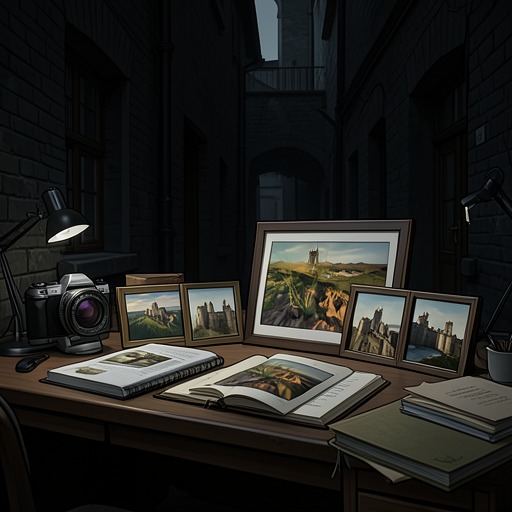
Holmes visits Hutton at the studio and finds photographs displayed along the walls. Hutton speaks of a window in a tenement across the way: people gathered there, and he put up curtains after seeing them. On one occasion he used a motor-drive camera to take a couple of quick photographs of the people at the window; they objected. The episode presents the camera as an instrument that can intrude on private activity, and the curtains as a response to that intrusion. Hutton’s account places questions about looking and being seen directly within the studio’s surroundings.
Among the photographs Holmes examines is an image of Edinburgh Castle in mist. He recognizes it as almost identical to a newspaper picture he has seen, and thus closely related to a picture in Ronnie’s bedroom. The resemblance connects Hutton’s displayed work with the investigation without, by itself, establishing who made or circulated every version. Hutton responds to Holmes’s interest by showing him other work, including a cluster of a dozen black-and-white ten-by-eight nude photographs. The subjects are men and women, not all young or conventionally attractive; Holmes considers the pictures well taken, even artistic. Hutton calls them only the best of his work, suggesting that the display is a selection rather than the full extent of his output.
Holmes’s Visit and the Photograph Taken
As Holmes browses, he praises particular photographs, and Hutton welcomes his attention, walking with him and pointing out angles and techniques. The exchange gives the visit the shape of an informal viewing: Hutton explains and displays, while Holmes looks closely. When Hutton turns away and apologizes for having snapped, explaining that he is tired, Holmes uses the moment to pick up a photograph from a selection on the floor and put it inside his jacket. He cannot do so stealthily. Arnold sees the act, and Holmes winks at him; Arnold does not tell Hutton. The photograph is removed from the studio with one witness knowingly keeping the act quiet, making the handling of images part of the scene’s action rather than merely its subject.
Before Holmes leaves, Hutton describes photography as demanding continuous thought and attention: in his view, everything a person sees can become material. That account resonates with the studio’s displayed images and with Holmes’s own purposeful scrutiny, but the visit also shows that looking does not guarantee a complete account of an image’s origins. Holmes leaves with a photograph, and Arnold has seen him take it; the evidence supplied does not establish that the photograph he takes is Tracy’s nude photograph later brought to Rebus.
The Studio Label as an Investigative Lead
Later, Holmes brings Rebus a nude photograph of Tracy and lays it on the desk without a verbal introduction. Rebus studies the image while Holmes gives his report, then turns it over and reads the small label on the back: Hutton Studios, followed by a business telephone number. The label makes the studio a concrete lead. It identifies a business to contact, rather than resolving who took the photograph or how it came to be connected to Ronnie’s pictures. Rebus tells Holmes he will consider what to do with it, and the image unsettles him; Holmes’s delivery also complicates their exchange, since Rebus had been wondering why Holmes had snubbed him the previous evening.
Rebus later uses the photograph to confront Tracy in the car. He proposes that she modeled for Hutton for money, brought him Ronnie’s pictures, and may have done so either for payment or to spite Ronnie. In Rebus’s account, Hutton could then have taken ideas from Ronnie’s work, while Ronnie would have had no way to know how Hutton obtained them. Rebus links this possibility to the strain between Tracy and Charlie and to the question of whether Ronnie had been betrayed by someone close to him. Tracy weeps, but the scene does not establish that his theory is true: Rebus explicitly recognizes that it is conjecture, and supposes Hutton might confirm the details if questioned. The studio’s role in this chain is therefore investigative and suggestive, not a proven record of what Tracy or Hutton did.
Images, Privacy, and Uncertainty
Hutton Studios brings together several different functions of photography: artistic work on the walls, images made by looking across at people in a neighboring building, and photographs that Rebus treats as possible evidence of a transaction involving Ronnie’s pictures. The contrast is significant. Hutton presents seeing as a constant source of photographic material, yet the window episode shows that the people photographed may object to being observed. Holmes’s unannounced taking of a photograph from the floor adds another instance in which control over an image is contested, while Arnold’s silence allows that act to pass without Hutton’s knowledge.
The studio’s label on Tracy’s photograph makes Hutton’s workplace visible in the investigation, but it does not settle the disputed provenance of Ronnie’s images. Instead, the location gathers clues whose meanings remain provisional: the Castle photograph resembles pictures encountered elsewhere, Tracy’s image points to Hutton, and Rebus’s accusation offers a possible route by which Ronnie’s work reached him. Hutton Studios matters because it gives those suspicions a specific place and a name, while preserving the distinction between a useful lead and a verified explanation.